
一 |
Editor's Note:
The outline of the 15th Five-Year Plan called for building a modern industrial system, consolidating the foundation of the real economy, and accelerating high-level technological self-reliance and self-strength to lead the development of new quality productive forces. These goals have provided clear direction for industrial transformation and upgrading across various sectors, while injecting strong momentum into high-quality development.
The Global Times has launched a new column titled "China Industry Close-up." Focusing on the creation of a new development pattern, the column will delve deeply into vivid examples of industrial transformation and upgrading across various sectors, aiming to showcase China's innovation-driven and high-quality development. This is the first half of the second installment of the series
Cao Jing, a truck driver based in Shenzhen, South China's Guangdong Province, carefully secured a humanoid robot at the research and development center of a local robotics company on Friday. With steady hands, he and other technical staff first folded the robot and placed it into a black box filled with cushioning pads, then moved the box into the back of his 4.2-meter-long truck, adjusting the straps and padding to keep it steady for the journey. Once everything was firmly in place, he climbed into the cab and set off along the Liuxian Road in Shenzhen's Nanshan district.
Half an hour later, he arrived at the Shenzhen Nursing Home, where the robot would soon begin its new role -serving as a cheerful companion for the elderly while continuously improving itself through daily real-scenario applications.
Cao, a driver for freight company Huolala's enterprise service, told the Global Times that since March and April, he can get four or five such delivery orders a day during peak times, mostly around Liuxian Road, a sharp increase from last year. "The robots I transport have also become much more diverse — from company R&D prototypes and household robots being delivered to customers' homes for testing, to robots designed for all kinds of competition, and even those fighting robots that compete in the octagon," Cao said as he waited at a traffic light on Liuxian Road.
The Liuxian Road is located within the 30-minute supporting circle in Shenzhen's "Robot Valley," an idea that Chinese official highlighted at the 2026 Summer Davos in June.
Just a decade ago, some of this area was little more than old industrial zones, construction sites and urban villages. Today, the Robot Valley — stretching about 10 kilometers along Liuxian Road and covering an area of approximately 28 square kilometers — has transformed into a thriving hub. The corridor is lined on both sides with robot makers, component suppliers, software algorithm firms, as well as universities and research institutions.
The area is now home to over 200 companies across the robotics industrial chain, including more than 25 humanoid robot complete-machine manufacturers, 32 specialized and sophisticated "little giant" enterprises, and 15 listed companies, according to local authorities.
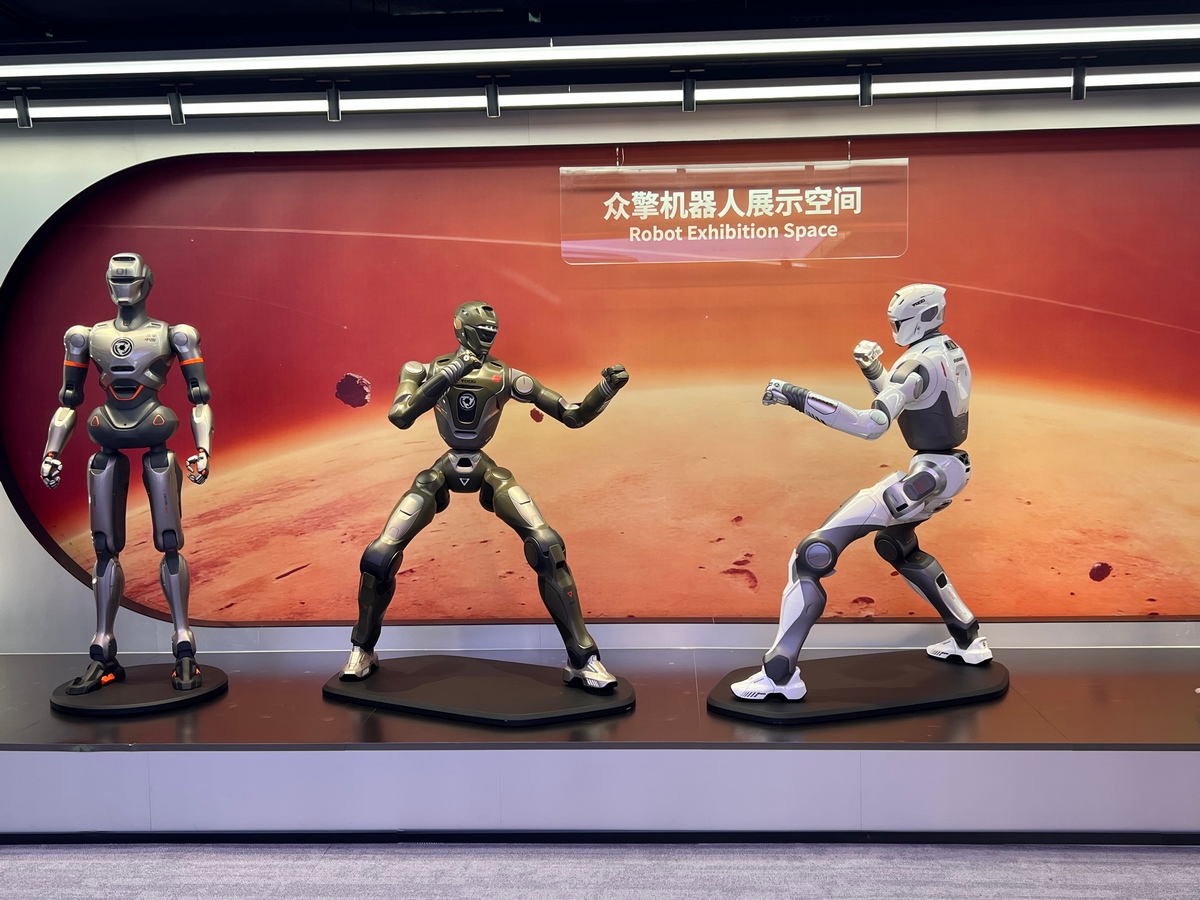
Walking through parts of the valley now feels like stepping into a sci-fi film, where it is common to encounter a "blinking" humanoid robot waving hands around the corner, watch a lively parade of dancing robot dogs and sip a coffee made by humanoid robot, or enjoy a dish prepared by robotic arms.
The rise of this high-tech futuristic valley offers a glimpse into the prowess of China's embodied artificial intelligence (AI) industry, one of the industries of the future identified in China's 15th Five-Year Plan (2026-30) that has drawn intensive global limelight. The valley also epitomizes China's homegrown innovation capabilities, where milestone technological breakthroughs, coupled with rapid iteration, complete industrial chains, and real-world application scenarios converge to turn cutting-edge research into tangible products at remarkable "Chinese speed."
'Half-hour circle'
When Global Times reporters visited Shenzhen robotic firm EngineAI's intelligent manufacturing base in the Robot Valley, several humanoid robots were effortlessly demonstrating high-difficulty moves such as front flips. Some of the T800robots, just backed from the Ultimate Robot Knock-out Legend (URKL), or what organizers billed as the world's first free humanoid robot fighting competition in July, were "battered and bruised."
"In robot combat, we must always be prepared for high-intensity real-world testing," Li Hao, a motion control algorithm engineer at EngineAI, told the Global Times. "Real combat takes place in a continuous, highly uncertain environment full of interference. The real challenge is ensuring that humanoid robots can continuously maintain stability under complex conditions such as moving, turning, punching, absorbing force, and shifts in the center of gravity. In this context, the pace of research and development (R&D), testing, and adjustment is particularly fast — which is why the half-hour industrial circle matters so much to us."
Li gave a vivid example of how his daily routine fully leverages the valley's tight integration of R&D, testing, and manufacturing.
"In the morning, I finish modifying the algorithm at the R&D center. A 25-minute drive then takes me to the production line at the valley's Honghualing manufacturing base for real-machine testing. By the afternoon, I can rush back to the R&D center to upgrade and optimize the algorithm again," he explained.
Since March, Li has been taking Muay Thai lessons together with other core engineers. While he has grown into something of a "Muay Thai master," this proximity of the Robot Valley also allows him to "communicate with robots" every day, optimizing intelligent recognition algorithms and motion strategies based on their performance in real combat. "This is like teaching a baby, and we're training the robots to grow stronger while becoming smarter, day by day," he noted.
Throughout the robot manufacturing, another critical step — robot prototyping — further highlights the unique strength of China's robotics industry.
Pang Jianxin, vice president of UBTECH, a Hong Kong-listed humanoid robot company also headquartered at the Robot Valley, told the Global Times that the valley holds a clear advantage in rapid prototyping and fast product iteration — an edge that "leads the world."
"During prototyping, the volume for production is usually very small, and many companies are reluctant to take on such orders. However, in Shenzhen and the broader Pearl River Delta, there are a large number of supply chain enterprises that are willing to accompany start-ups on new tracks and new products. Based on the design, they can leverage their experience to select suitable materials or processes, quickly complete sample manufacturing, and then rapidly verify the results. This is crucial for hardware R&D, especially for innovative hardware and intelligent robots," Pang explained.
In overseas markets such as the US, the typical process from turning an idea into a physical product, to producing samples and entering the small-scale market, and finally reaching mass production and making debut, could take five-to-ten times longer than the Chinese counterparts, Liu Shaoshan, director of the Embodied AI at the Shenzhen Institute of Artificial Intelligence and Robotics for Society, told the Global Times. Liu has worked in the US for a bunch of years before returning to Shenzhen two years ago.
"Robotics is an industry where speed almost decides everything - as half of it is manufacturing, and the other half is about R&D," Liu told the Global Times.
According to Liu, in the US, it can take a week just for industrial chain communication to implement a hardware change or upgrade, and most of their suppliers are located outside the country, which further delays the process. By contrast, the complete supply chain of Shenzhen's Robot Valley enables highly efficient communication — "in some cases, suppliers can even arrive on site within half an hour."
The Global Times also noticed a telling scene during its week-long visit to Shenzhen's Robot Valley: the company visited on the first day turned out to be the exact supplier of the company visited on the second day, while the third-day institute was itself a key testing partner of the second-day company — further underscoring the tightly integrated industrial ecosystem that makes rapid iteration possible.
For embodied intelligence manufactures, the Robot Valley is home to a full range of upstream suppliers — from perception systems such as tactile sensors and LiDAR, to actuation systems including servo motors and joint modules, and core components like robotic arms and dexterous hands. Meanwhile, downstream, large-scale manufacturers in the auto, new energy and electronic industries stand ready to put these robots into broader real-world applications, industry insiders noted.
"Many of the embodied robotics companies in the valley are our customers. Some of them — such as UBTECH, X Square and PUDU — are within a 20-minute drive of our headquarters. It is not an exaggeration to say that if you want to build a robot in Shenzhen's Robot Valley, you can easily find the suppliers you need nearby," Zhao Qiyu, marketing director of publicly listed robotics and AI vision company Orbbec, told the Global Times.
Meanwhile, as China's robotics industry continues to expand, downstream customers are developing increasingly specialized and specific requirements, encouraging companies like Orbbec to launch new products that address these evolving needs, Zhao said.
She cited one of the company's newly launched products, EGO, a head-mounted data collection device designed to capture first-person perspectives and real-world task flows. By collecting multimodal data related to environmental semantics, spatial scale and long-horizon task chains, the device helps generate high-quality training data for downstream embodied AI model companies.
'DeepSeek' moment in robotics industry
Pang from UBTECH recalled firsthand how he has witnessed the drastic change in Shenzhen's Robot Valley and the broader picture of the Chinese robotic industry during the past 10 years.
"When we started the company a decade ago, what we saw from the window was just old industrial base, some construction sites and villages. We were like marching through a dark desert, where even the positions of the stars and the moon could not be seen clearly," Pang said.
He noted that at that time, the most well-known robotics companies on the international stage were the US-based Boston Dynamics, which wooed the world with its signature backflips and parkour moves, and Honda from Japan, whose humanoid robot ASIMO became a global icon. In the Chinese market, domestic companies specialized in humanoid robots "were extremely scarce."
However, a decade later, China's robotics industry has undergone what industry insiders described as "transformative changes," shifting from a follower to a frontrunner. The once "valley of entrepreneurship" has also transformed into a world-class "highland of innovation," Liu Zhufu, deputy general manager of Dobot Robotics, which was founded in 2015, told the Global Times.
Today, China has firmly established itself in the world's first tier of the robotics industry, with Chinese robotics companies having increasingly become a must-visit destination for foreign heads of state during their trips to China - as vividly exemplified by Slovak President Peter Pellegrini's tour of a robotics mall in Beijing's Yizhuang in July and President of Myanmar Min Aung Hlaing' visit to the Unitree Robotics in June.
According to data released by Beijing CCID Publishing & Media Co, China accounted for 84.7 percent of global humanoid robot shipments in 2025, meaning that for every 10 humanoid robots sold worldwide, more than 8 carried the "Made in China" label.
The institute Liu Shaoshan works for has also received a number of officials from Europe, including former UK Foreign Secretary Yvette Cooper, as well as corporate delegates from Europe, Japan and South Korea in recent months.
"Many foreign visitors, during their inspections in Shenzhen, would ask me similar questions — why have cutting-edge technologies such as AI and embodied intelligence developed particularly rapidly in China? What can they learn, and what role should their governments play in accelerating this development?"
The answers, according to Liu, lie not in a single technological breakthrough, but in a combination of long-term strategic planning, industrial cultivation, and ecosystem building. "It is precisely thanks to the forward-looking layout and top-level design that China has gradually formed a complete chain spanning basic research, core technology breakthroughs, and industrial applications, while gaining a first-mover advantage in the real-world deployment of robots," Liu stressed.
"China has been promoting the development of the humanoid robotics industry with unprecedented strategic resolve. And the inclusion of intelligent AI into the 15th Five-Year plan (2026-30) carries a lot of significance: it is not only a policy dividend but also offers long-term strategic guidance. It will guide more resources toward core technology breakthroughs and industrial ecosystem building, accelerating the process of humanoid robots moving from the laboratory to factories and into households," Pang said.
When it comes to the local practice echoing this top-level design, the authorities in Shenzhen's Nanshan District have so far opened a total of 68 public scenarios for robot applications, aiming to open up the full chain of "technology R&D - scenario verification - commercial promotion," the Global Times learned.
Encouraged by these developments, industry insiders in the Robot Valley are increasingly optimistic that a "DeepSeek moment" for China's homegrown robotics industry may arrive sooner rather than later.
This moment may not come in a single instant, but a process accumulated from countless "world's firsts" - fueled by continuous homegrown technological breakthroughs and the constant expansion of application scenarios across China.
"Maybe one day, robots will be able to produce robots right here in our manufacturing base—that could be a defining 'DeepSeek moment'," Yao Qiyuan, co-founder of EngineAI, told the Global Times.
。 洪俊扬和老婆杜蕙甹剧里饰演夫妻。

二 | (载自视频) (新加坡讯)洪俊扬近日在社媒贴出与电视剧《浴水重生》监制谢光华的合照,表示很开心有机会客串,由于剧中与太太杜蕙甹演夫妻,所以他写到:“只是我的老婆可能比较希望有一位比较会演戏的演她老公”。

三 | 洪俊扬在接受《新明日报》访问提及他在社媒的留言,他说演员是需要彼此刺激,给对方戏,“所以感觉我算是一个负担,如果有更好的演员跟她演夫妻的话,她可能可以演得更好。

四 | ”杜蕙甹开玩笑说:“其实谁演我老公都可以,只要不是洪俊扬就行了。”她解释,因为她在剧中演失明人士,很考演技,压力非常大,希望能有一个比较会演戏的人跟她对戏,帮她入戏。这次夫妻俩相隔6年再合体演戏,同时又演夫妻,洪俊扬感觉很棒,也让他比较有安全感和自在。

五 | 而杜蕙甹则表示没有特别的感觉,只是不会担心彼此NG。

六 | 说到演技,洪俊扬觉得自己的演技非常普通,还有很多地方需要加强。不过杜蕙甹认为老公的演技不错,“他非常努力,也很虚心学习,已经是在他的能力范围内做到最好了,毕竟他主要的领域是音乐。”对于自己的演技,杜蕙甹说有待进步,“虽然做足了功课,但我缺少经验,很多时候没有办法把自己想表达的情绪好好呈现出来。”李博翔在《浴水重生》演技获赞。(互联网)

七 |

八 | 人在台湾的李博翔接受《新明日报》访问时,对观众给出的评价受宠若惊。他说,这并非他首次扮演残障人士,还自曝导演原本设定他是双腿残疾,后来因剧情需要才变成单脚残疾。他直言为角色做了很多功课,还透露剧中另一位演员段伟明成为了他很好的借鉴。“我有在片场偷偷观察段伟明大哥,但我没去问他,因为我不想在别人伤口上撒盐,段大哥是很乐于分享的人,他的外表形象看起来很正面,但他一定有一个我们所不知道的辛苦过程,我在他相处聊天时,就会偷偷观察他的心态与状态,是我模仿学习的一个对象。”李博翔来本地拍戏已有一两年,但部分观众仍以为他是新人,对于观众“不熟”,他开玩笑希望能因此而角逐明年《红星大奖》新人奖。图、文:联合早报。
Current article:http://j7f83h.tourunbiaodubaicubangninan.shop/news/20260826_7856.html
Published on:22:33:16
世界第一等
倚天屠龙记
打架成本警示牌
大秦帝国
影视风云路
海派甜心

